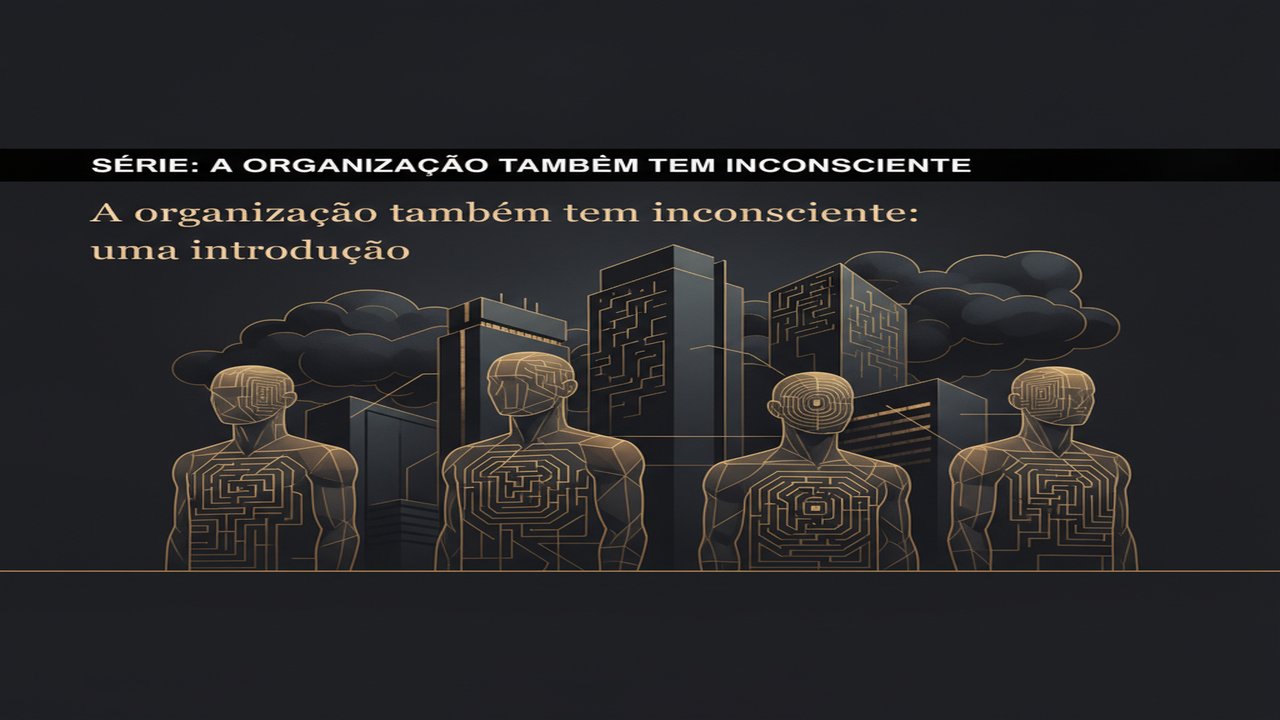
Organizations like to explain themselves. They have strategies that tell them where they want to go, values that describe how they want to behave and structures that distribute responsibilities. When something doesn't work, look for causes, identify those responsible and create action plans. There is a necessary rationality in this effort. No organization would be able to function if it were not capable of transforming part of its complexity into objectives, processes and decisions. The problem begins when we start to believe that what the organization can explain about itself corresponds to everything that actually makes it work..
Everyday experience suggests something different. Companies defend autonomy and continue to concentrate decisions. Leaders say they want people who challenge them, but they progressively surround themselves with those who agree with them. Organizations recognize certain problems, invest resources to resolve them and, a few years later, discover surprisingly similar versions of the same difficulties. In other cases, Everyone seems to know something is wrong, although no one can talk directly about it. There are still people who become repositories of almost all of a group's problems and crises that return despite changes made to prevent their recurrence.. Separately, every situation can find a reasonable explanation. Observed together, they pose a more uncomfortable question: perhaps an organization is not entirely capable of knowing why it does what it does.
It is at this point that psychoanalysis becomes an interesting interlocutor for the world of work. Freud produced an important rupture by questioning the idea that the subject has transparent access to the reasons for their own behavior. The unconscious does not simply mean that there is information hidden somewhere in the mind. Its implication is deeper because it calls into question the sovereignty of consciousness. We can desire something and act in the opposite direction, repeating experiences that make us suffer or constructing perfectly coherent explanations for behaviors whose determinations we do not fully understand. What we know about ourselves is true, but not necessarily enough.
An organization, evidently, is not a person. No childhood, desires or psychic apparatus, and it would be a mistake to transform concepts built to understand subjects into business diagnoses. When this series talks about the organizational unconscious, therefore, does not intend to suggest that companies can be put on the couch. The approximation is interesting for another reason. Organizations are made up of people who establish bonds, fight for recognition, exercise authority and collectively construct ways of dealing with risk, conflict and uncertainty. When these relationships are repeated for long enough, some of them become patterns that no longer need to be consciously chosen to continue producing effects.
This perspective allows you to observe known phenomena from a different angle.. Faced with resistance to change, for example, the usual question seeks to find out how to overcome it. A reading inspired by psychoanalysis might first ask what that resistance protects. Faced with dysfunctional behavior, the tendency is to eliminate it. It may also be useful to understand what role it plays. When a certain person seems to focus all of a team's problems, we can hold her responsible for what she actually does without abandoning the question of why the group found her such a convenient place to deposit their tensions. The change is less in the answers offered than in the questions that become possible.
This also requires avoiding a common temptation when psychological concepts enter the management vocabulary.. Narcissism, projection, resistance and trauma can become sophisticated labels to judge behaviors that we do not understand. In this use, psychoanalysis adds little and still creates a false impression of depth. The objective here will be exactly the opposite. A concept is only interesting if it manages to make the phenomenon more complex than it initially seemed., forcing us to consider relationships and contradictions that a more immediate explanation would miss.
Throughout the texts that make up this series, the organization will be observed from its repetitions, of your symptoms and what you find difficult to say. The ways in which groups preserve certain solutions even when they have already begun to produce problems will also appear.. This is not to say that every conflict has an unconscious cause or that management difficulties should receive psychoanalytic interpretations.. Bad processes remain bad processes, Inadequate incentives need to be corrected and people must be held accountable for the decisions they make. Psychoanalysis becomes more useful precisely where these explanations are needed, but they are no longer enough.
Perhaps this is the hypothesis that runs through the entire series.. To understand an organization, It's not enough to listen to what she says she wants to be. It is also necessary to observe what she repeats, the contradictions it manages to sustain and the problems it seems unable to say goodbye to. In some moments, What most reveals an organization is not its declared values or its strategy, but in the persistent distance between what it intends to produce and what, despite all your good intentions, continues producing.
It is at this distance that we will begin.