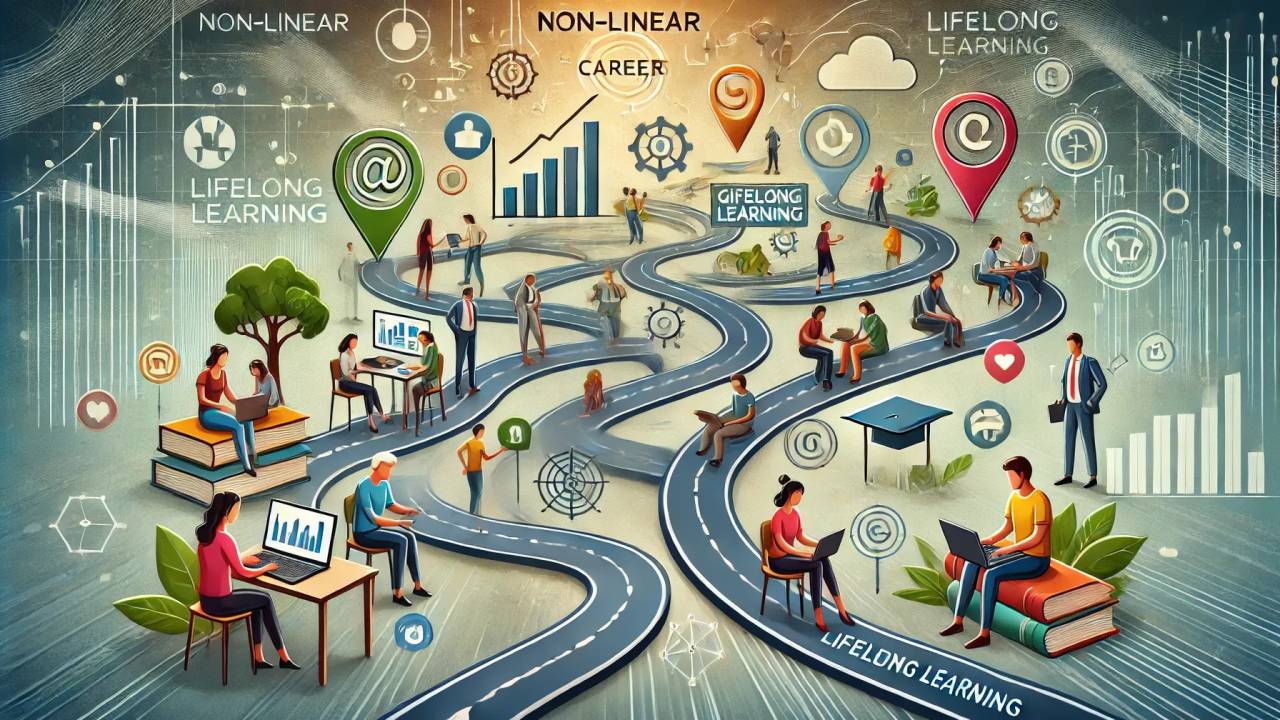
In recent years, the concept of a linear career — one that follows a predictable path of growth within a single organization or sector — has become increasingly less relevant in the current professional scenario. Non-linear careers, characterized by frequent job changes, sector or even profession, are emerging as the new normal. According to a Deloitte report from 2020, career longevity, combined with rapid technological and organizational transformations, is reshaping the traditional career path, requiring workers to adopt a more flexible and resilient mindset.
Non-Linear Career Trends
Non-linear careers reflect a reality in which professionals can move between different roles and industries throughout their lives, driven by a variety of factors, including the search for personal fulfillment, technological changes, economic crises and globalization. A McKinsey study points out that around 60% of current jobs have at least 30% of activities that can be automated, which reinforces the need for continuous adaptation and development of new skills.
Besides that, the rise of new forms of work, like freelance work, gigs, and own ventures, also contributes to this new paradigm. Upwork's survey of 2022 revealed that approximately 36% of the workforce in the United States is made up of freelancers, many of whom chose this path due to the flexibility and ability to explore multiple professional interests.
The Need for Life Long Learning
In this context of non-linear careers, the concept of “life long learning” — or lifelong learning — becomes essential. Continuous learning is seen as an imperative to remain relevant in the job market. According to a report by the Organization for Economic Co-operation and Development (OECD), 50% of workers will need requalification until 2030 to keep up with technological and organizational transformations.
Continuous learning allows professionals to quickly adapt to changes and develop skills that are required in different contexts. However, This model also presents challenges. Not all individuals have equitable access to learning opportunities, whether due to financial limitations, lack of time or lack of organizational support. Besides that, Too many learning options can lead to information overload, making it difficult for professionals to identify which skills will really make a difference in their careers.
“The real key to success in non-linear careers is the ability to learn, unlearn and relearn, além de saber como se posicionar em um mundo onde o único constante é a mudança.” — Alvin Toffler, futurista e autor.
Limitações do Life Long Learning
Embora o aprendizado contínuo seja crucial, ele também tem suas limitações. O principal desafio reside na capacidade das pessoas de aprender a operar dentro desse novo contexto de carreiras não-lineares. Não é suficiente apenas adquirir novas habilidades; é necessário entender como aplicá-las em cenários incertos e em rápida transformação. A pesquisa de David Epstein em seu livro “Range: Why Generalists Triumph in a Specialized World” destaca que, embora a especialização possa ser benéfica, a adaptabilidade e a capacidade de pensar de forma ampla e interconectada são ainda mais valorizadas em um ambiente profissional dinâmico.
Outro ponto importante é o equilíbrio entre o desenvolvimento de habilidades técnicas e as chamadas “soft skills”, como a resiliência, capacidade de colaboração e pensamento crítico. A pressão por aprender constantemente pode levar ao burnout e à exaustão, especialmente em um contexto onde as linhas entre vida pessoal e profissional estão cada vez mais tênues. Isso exige um novo tipo de literacia digital e emocional para que os indivíduos possam gerenciar suas carreiras de maneira sustentável.
Like this, as carreiras não-lineares e o life long learning caminham juntos como parte de uma nova realidade no mundo do trabalho. However, para prosperar nesse ambiente, é necessário mais do que aprender continuamente — é preciso aprender a navegar a incerteza, a reconhecer oportunidades em meio ao caos e a valorizar a adaptabilidade como uma competência central.