There is something particularly intriguing about organizations that go through transformation processes. In many cases, there is reasonable agreement on what needs to change, problems have been identified and the people involved seem sincerely committed to change. Even so, after some time, old behaviors begin to reappear. A company that decided to decentralize its decisions finds that almost everything continues to reach senior leadership. Another states that it wants to stimulate innovation, but it creates so many control mechanisms that any different initiative needs to go through successive approval instances. There doesn't necessarily appear to be anyone sabotaging the change. Often, everyone seems genuinely interested in making it happen. This is precisely what makes the phenomenon interesting.
The most common explanation usually resorts to the idea of resistance. People resist change because they prefer what they know, are afraid of losing power or have not yet sufficiently understood the benefits of the new model. There are situations where this happens, but the explanation becomes limited when we realize that repetition does not depend only on the individual will. People who arrived later reproduce behaviors that were never formally taught to them. Managers who publicly defend autonomy centralize decisions when they feel pressured. Teams that complain about excessive control immediately seek out superiors when they need to take a risk. Little by little, it becomes difficult to maintain that we are only faced with conscious choices. Something seems to circulate throughout the organization without it being possible to locate exactly who determined it.
Psychoanalysis was born, largely, the attempt to understand similar phenomena in the individual. Freud realized that an important part of psychic life could not be explained by the consciousness that each person had of themselves.. Symptoms, forgetfulness and repetitive behaviors cast doubt on a very comfortable idea: that we know why we do what we do. The most profound contribution of the idea of the unconscious may be precisely in removing from consciousness the place of absolute command over the subject.. We can consciously desire one thing and repeatedly act in another direction, not because we are lying about what we want, but because our action is also crossed by conflicts that we do not entirely control.
Transporting this idea to organizations requires care. An organization does not have a psychic apparatus and does not repress experiences like a person. Talking about the organizational unconscious is, therefore, use an interpretation key, not attributing personality to the company. Organizations are, However, made up of people who establish links, occupy positions of authority and develop collective ways of dealing with the anxiety produced by work. When these relationships are repeated for long enough, can produce patterns that no longer depend directly on those who created them. A certain way of reacting to error, for example, may have started with an extremely controlling founder and continue to exist many years after his departure, supported by people who have never worked with him.
It is possible to observe this process in companies that try to increase the autonomy of their teams. Responsibilities are redefined, approval levels are reduced and managers are told that they now have greater freedom to decide. Faced with a delicate situation, however, the manager consults his superior. The superior participates in the decision. When someone decides alone and the result is not good, The question arises as to why leadership was not consulted sooner. None of these events appear particularly serious when observed in isolation., but the sequence teaches a rule that does not appear in any document: deciding is allowed, although sharing the decision in advance is safer. In a short time, autonomy exists formally while dependence continues to organize everyday behavior.
An administrative reading could conclude that responsibilities have not been sufficiently clarified or that managers need to be prepared to take on greater leadership. Maybe they need. But there is another possible question: what does this dependency protect? It can reduce the anxiety of those who need to take a risk, while protecting those who lead from the feeling of losing control. It can preserve an image built over the years that certain people are indispensable for important decisions. In this case, what appears as an operational deficiency also plays a role for the people involved. Removing the behavior without understanding this function may only cause it to find another way to manifest itself..
This perspective helps to understand why some transformation initiatives fail despite being technically well designed. Management usually acts on the visible manifestation of the problem. If there is little collaboration, collaboration rituals are created. If there is low autonomy, elevations change. If there is a lack of new ideas, an innovation program is established. These interventions assume that the undesired behavior exists because adequate conditions for the desired behavior have not yet been created.. This is often true. In other situations, However, the old practice continues to fulfill a function that the new structure was unable to replace. The organization tries to remove an answer without realizing which question that answer was solving.
This is why repetition is perhaps more revealing than the isolated episode. Every organization makes mistakes and makes contradictory decisions. None of this, if s & oacute;, requires a deeper interpretation. The issue changes when certain patterns outlive people and reforms designed to eliminate them. When successive managers face similar difficulties or a problem returns in new forms after apparently being resolved, It may be useful to abandon for a moment the question about who is making the mistake and observe what the system itself continues to produce.
This does not mean transforming any business difficulty into an unconscious manifestation. There are organizations with bad processes, poorly designed incentives and unprepared managers, and psychoanalysis loses value when it is used to make mysterious what can be explained in a simple way. Your contribution becomes more interesting when obvious explanations are no longer sufficient., especially in the face of a persistent distance between what the organization claims to want and what it continues to produce despite its efforts.
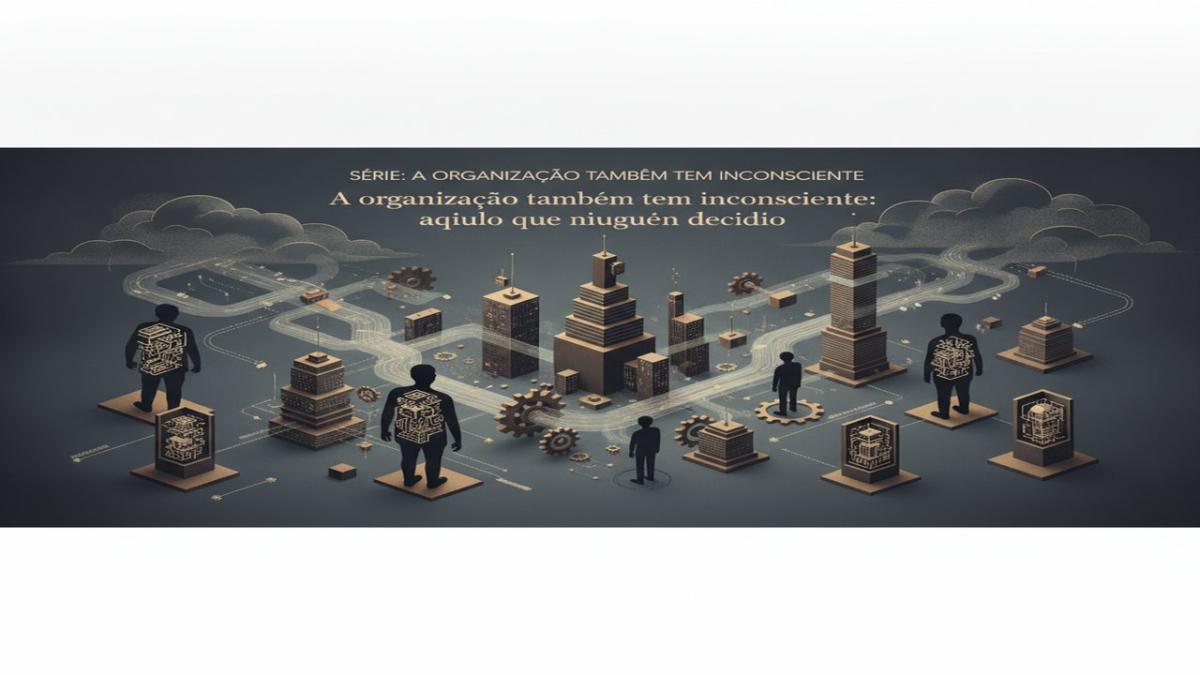
Perhaps it is in this space that the idea of an organizational unconscious becomes productive.. Not as an entity hidden somewhere in the company, but as relational patterns that continue to operate without needing to be consciously decided each time. They appear in what can or cannot be said, in disproportionate reactions to certain events and, mainly, in situations that seem destined to repeat themselves. For those who lead, the question then stops being just what needs to change. You may also need to ask what the organization would lose if that change actually happened..
This question shifts the transformation from the comfortable terrain of intentions to what certain behaviors offer people. A company may sincerely desire to decentralize and, at the same time, find security in the concentration of power. Can champion innovation while preserving mechanisms that reduce uncertainty. May want independent people and continue to reward those who seek validation. Some changes, therefore, require more than defining new behaviors. They demand to understand why the old ones were necessary and create conditions for them to stop being so. Until that happens, the past continues to find ways to participate in the present, even when no one else remembers exactly where it came from.