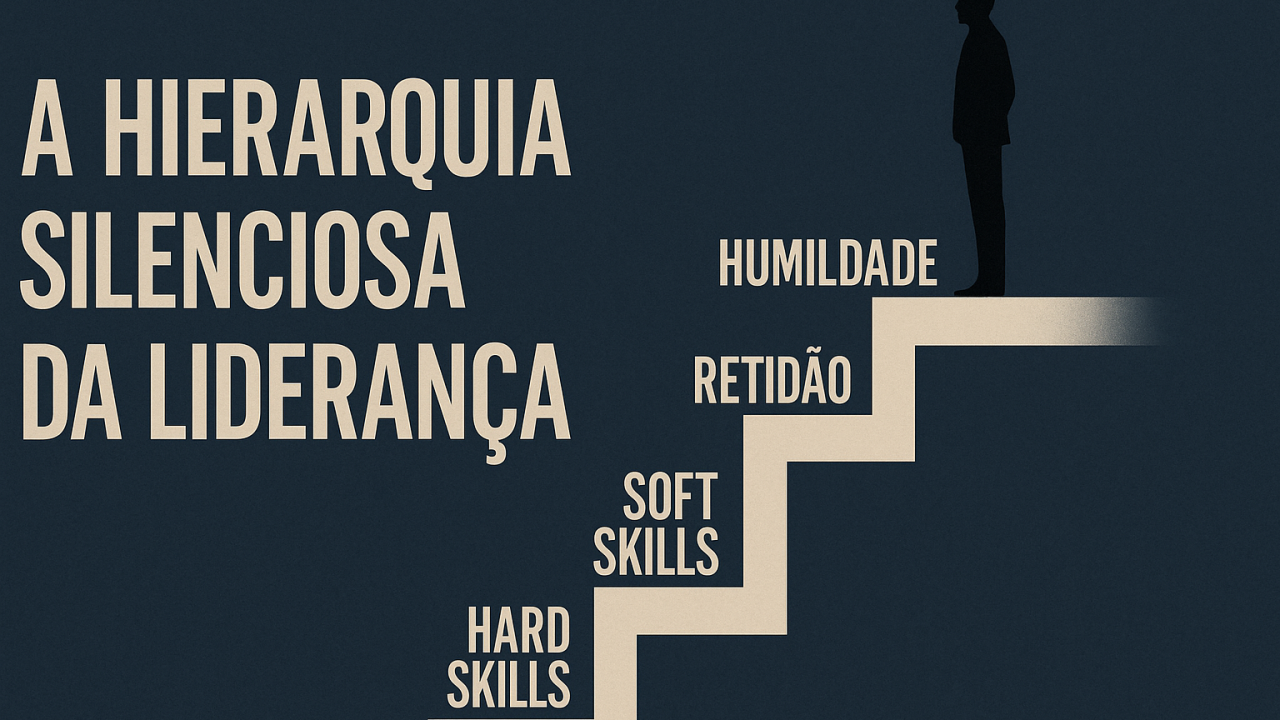
In times of high performance, exponential technologies and seductive speeches about the “future of work”, there is something that remains almost invisible — but decisive — in the exercise of leadership: the silent hierarchy of human qualities. It does not appear in quarterly reports, not even in productivity dashboards. But it is what determines, in the long term, the difference between those who just occupy a position and those who truly lead. E, in this hierarchy, humility is what sustains everything else.
Humility: the intelligence that listens
Executive humility is not synonymous with subservience or shyness. She is, paradoxically, a high form of intelligence. The humble executive understands that the place of listening is not a step below command — it is the basis of command that works. Truly listening is not just hearing words, but capture contexts, perceive emotional nuances, read between organizational lines. It's understanding that the other - even the most junior, the most discredited — can carry the missing piece to the puzzle of a good decision.
This humility allows us to look at problems with less of a rush to solve them and more willingness to understand them.. The leader who listens deeply sees better. He stops being the center of the answers and becomes the orchestrator of the questions. E, in this movement, creates an environment where people feel respected, included and, therefore, more willing to contribute.
Humility also protects the executive from one of the most dangerous vices of power: the illusion of certainty. When a leader believes that his trajectory automatically justifies his convictions, he starts to move away from reality. Humility is the force that prevents this distancing. It anchors the leader in the present, in the other, in context — and keeps you lucid.
Righteousness: the foundation of coherence
The second characteristic is righteousness. In an increasingly cynical and instrumentalized environment, Maintaining principles can seem like a luxury — or naivety. But it's exactly the opposite: It's what remains when everything else wavers. Righteousness is practical coherence between values, speech and behavior. It's not about moralism, but solid.
A straight executive inspires confidence not because of what he promises, but for what it embodies. Your arguments have weight because they come from a place of integrity inside. When there is righteousness, authority does not need artificial reinforcements. She imposes herself silently, because it is perceived as real. Righteousness also allows you to sustain difficult decisions with serenity, because they are not tactical improvisations, but consistent developments of an ethical vision.
And more: righteousness sustains character in environments where pressure for results could justify deviations. She is the boundary between leading firmly and manipulating skillfully.. Between generating adherence and producing obedience. In & uacute; last & inst acirc; INSTANCE, righteousness doesn’t just protect the executive’s reputation — it protects the organization’s culture.
Soft skills: the new hard core of leadership
For a long time, The so-called “soft skills” were seen as collateral skills — important for those who lead people, but irrelevant for those who deal with strategy, numbers or operations. Today, this look is not only obsolete: it's dangerous.
Soft skills are the new hard core of leadership. Negotiate, communicate with empathy, give structured feedback, navigate conflicts, cultivate psychologically safe environments — all of this is no longer “complementary”: is essential. These skills set the tone for relationships, the quality of decisions and the sustainability of changes.
Soft skills are not innate talent or emotional props. These are skills that require training, reflection and provision for others. And unlike technical skills, that age with market updates, soft skills mature over time. They are what give the executive the necessary thickness to deal with complexity, without resorting to dangerous simplifications.
Hard skills: what is necessary, but not enough
Lastly, come the hard skills. They are important, Of course — no one can sustain a career without technical knowledge. But in executive positions, specialization loses space to the ability to articulate. Decisions stop being technical and become political, cultural, strategic.
Knowing how to do well is no longer enough. You need to know what, When, with whom, for what — and with what consequences. Technical mastery is the basis of competence, but not the ceiling of leadership. And when an executive clings to hard skills as if they were the only pillar of his authority, it can be surpassed not by someone more technical, but by someone more human.
Conclusion & atilde; the: leadership as a listening practice, ethics and maturity
Real leadership is an everyday practice of listening, ethics and maturity. It is not built with slogans, nor with management manuals. It’s built on small gestures, in difficult decisions, in encounters with others.
Humility and righteousness are not “spiritual” attributes of an idealized leader — they are practical tools for those who want to build lasting alliances, reliable environments and results that do not take away from the soul what they deliver in numbers.
Maybe this is the new skill of the 21st century: lead not from the position, but from consciousness. And that requires more than technique — it requires humanity.