How learning institutions are born, grow and change
By Rodrigo Cintra
Education is not ending. What is at stake is the model we built to organize it.
Why we trust diplomas? Why do we group students by age?? Why we come to believe that learning is the same as attending an institution?
The debate about the future of training often revolves around symptoms: soaring costs, questioning the real value of certificates and the proliferation of artificial intelligence. It is tempting to group these noises together under the idea of a generalized education crisis.. But is the problem our ability to learn or the institutional architecture we create to manage this need??
The story behind institutional ties
Learning has always existed before and outside the classroom — in families, workshops, communities and in the work environment itself. Schools and universities achieved a central position not because they invented knowledge, but because they solved complex problems of social coordination: select knowledge, certify skills and create reliable public trajectories on a large scale.
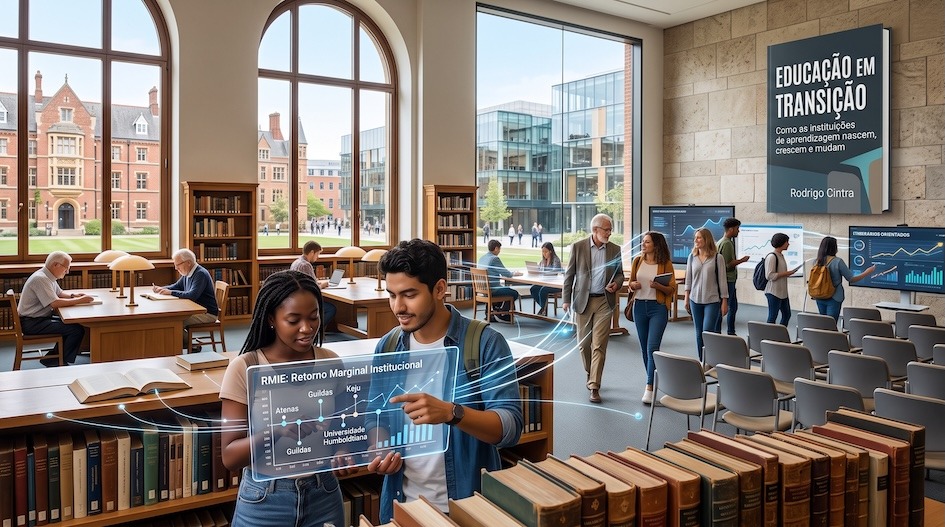
InEducation in Transformation, Rodrigo Cintra deconstructs myths and easy certainties to investigate the anatomy of these organizations. Traversing decisive moments in history — from the dispute between rhetoric and philosophy in classical Athens to the rigorous examinations of imperial China; from medieval craft guilds to the invention of the research university and the mass school —, the work demonstrates how rules, bureaucracy and standardization were brilliant solutions in the past that, over time, generated increasing social costs and resistance to change.
By confronting this heritage with the digital threshold and the rise of artificial intelligence, the book reveals that the true contemporary turnaround does not lie in the disappearance of institutions, moredecomposition of its functions. When access to content and explanation becomes instantaneous, cheap and abundant, which still justifies the existence of the school and university?
More than predicting collapses or selling passing pedagogical formulas, This is rigorous and indispensable research for educators, managers, researchers and leaders who need to discern which educational arrangements will continue to merit relevance and trust.
What you will find in this work:
Learn ≠ School: The fundamental distinction between the ongoing human need to learn and the bureaucratic arrangements erected to manage this process.
The history laboratory: Practical lessons from classical Athens, of the systemCheese Chinese, of medieval guilds and the consolidation of state education systems.
The Institutional Marginal Return on Education (RMIE): An analytical model to diagnose why to add more years of course, Bureaucratic layers and compliance requirements do not always deliver real-world capabilities.
Learning in the age of AI: When data transmission and compilation becomes commoditized, why dimensions like critical judgment, responsibility, coexistence and supervised practice become the most scarce and valuable assets.
The polycentric horizon: Why the future does not point to the end of institutions, but for the distribution of its old functions among new actors and trusted ecosystems.
To access the book for free, complete the registration below: