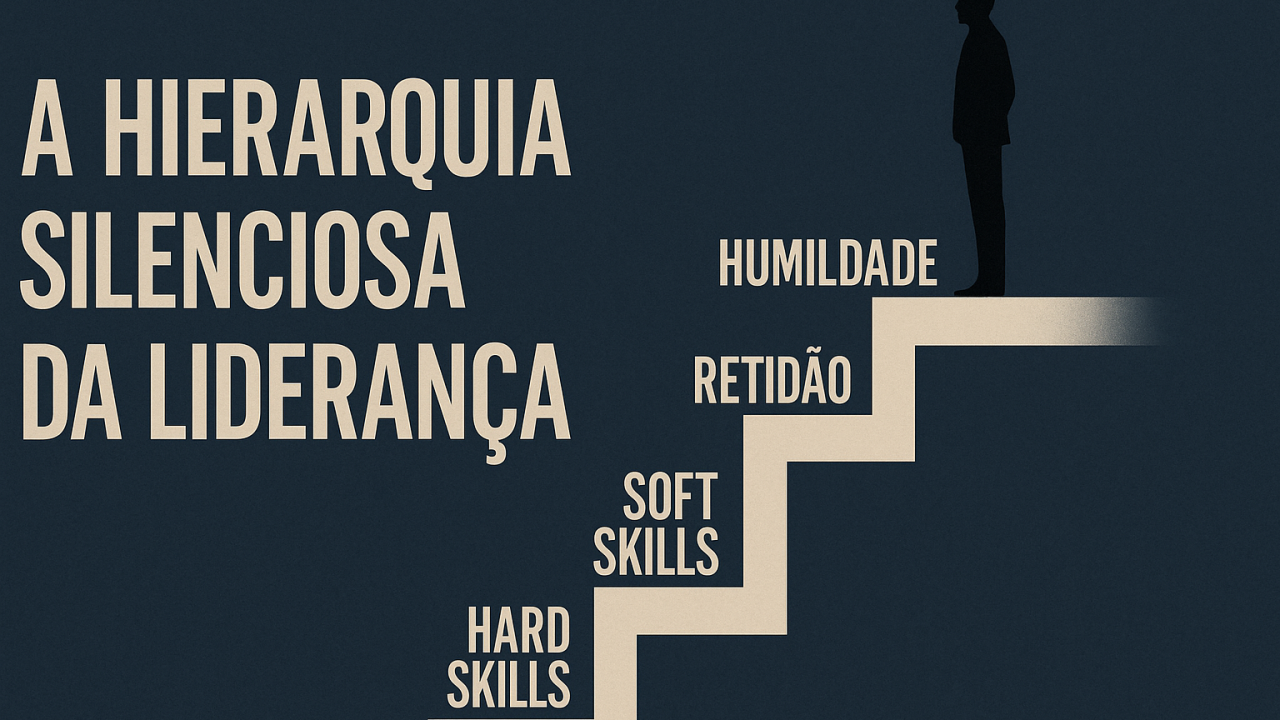
In times of high performance, exponential technologies and seductive speeches about the “future of work”, there is something that remains almost invisible — but decisive — in the exercise of leadership: the silent hierarchy of human qualities. It does not appear in quarterly reports, not even in productivity dashboards. But it is what determines, in the long term, the difference between those who just occupy a position and those who truly lead. E, in this hierarchy, humility is what sustains everything else.
Humility: the intelligence that listens
Executive humility is not synonymous with subservience or shyness. She is, paradoxically, a high form of intelligence. The humble executive understands that the place of listening is not a step below command — it is the basis of command that works. Truly listening is not just hearing words, but capture contexts, perceive emotional nuances, read between organizational lines. It's understanding that the other - even the most junior, the most discredited — can carry the missing piece to the puzzle of a good decision.
This humility allows us to look at problems with less of a rush to solve them and more willingness to understand them.. The leader who listens deeply sees better. He stops being the center of the answers and becomes the orchestrator of the questions. E, in this movement, creates an environment where people feel respected, included and, therefore, more willing to contribute.
Humility also protects the executive from one of the most dangerous vices of power: the illusion of certainty. When a leader believes that his trajectory automatically justifies his convictions, he starts to move away from reality. Humility is the force that prevents this distancing. It anchors the leader in the present, in the other, in context — and keeps you lucid.
Righteousness: the foundation of coherence
The second characteristic is righteousness. In an increasingly cynical and instrumentalized environment, Maintaining principles can seem like a luxury — or naivety. But it's exactly the opposite: It's what remains when everything else wavers. Righteousness is practical coherence between values, speech and behavior. It's not about moralism, but solid.
A straight executive inspires confidence not because of what he promises, but for what it embodies. Your arguments have weight because they come from a place of integrity inside. When there is righteousness, authority does not need artificial reinforcements. She imposes herself silently, because it is perceived as real. Righteousness also allows you to sustain difficult decisions with serenity, because they are not tactical improvisations, but consistent developments of an ethical vision.
And more: righteousness sustains character in environments where pressure for results could justify deviations. She is the boundary between leading firmly and manipulating skillfully.. Between generating adherence and producing obedience. In & uacute; last & inst acirc; INSTANCE, a retidão não protege apenas a reputação do executivo — protege a cultura da organização.
Soft skills: o novo núcleo duro da liderança
Durante muito tempo, as chamadas “soft skills” foram vistas como habilidades colaterais — importantes para quem lidera pessoas, mas irrelevantes para quem lida com estratégia, números ou operações. Today, esse olhar não apenas está obsoleto: é perigoso.
As soft skills são o novo núcleo duro da liderança. Negociar, comunicar com empatia, dar feedback estruturado, navegar conflitos, cultivar ambientes psicologicamente seguros — tudo isso não é mais “complementar”: é essencial. São essas habilidades que definem o tom das relações, a qualidade das decisões e a sustentabilidade das mudanças.
Soft skills não são talento inato nem adereço emocional. São competências que exigem treino, reflexão e disposição para o outro. E diferentemente das habilidades técnicas, que envelhecem com as atualizações do mercado, as soft skills amadurecem com o tempo. São elas que dão ao executivo a espessura necessária para lidar com a complexidade, sem recorrer a simplificações perigosas.
Hard skills: o necessário, mas não suficiente
Lastly, vêm as hard skills. Elas são importantes, claro — ninguém sustenta uma carreira sem conhecimento técnico. Mas em cargos executivos, a especialização perde espaço para a capacidade de articulação. As decisões deixam de ser técnicas e passam a ser políticas, culturais, estratégicas.
Saber fazer bem já não basta. É preciso saber o que, When, com quem, para quê — e com quais consequências. O domínio técnico é o chão da competência, mas não o teto da liderança. E quando um executivo se agarra às hard skills como se fossem o único pilar da sua autoridade, ele pode ser ultrapassado não por alguém mais técnico, mas por alguém mais humano.
Conclusion & atilde; the: a liderança como prática de escuta, ética e maturidade
A liderança real é uma prática cotidiana de escuta, ética e maturidade. Ela não se constrói com slogans, nem com manuais de gestão. Constrói-se nos pequenos gestos, nas decisões difíceis, nos encontros com o outro.
Humildade e retidão não são atributos “espirituais” de um líder idealizado — são ferramentas práticas de quem deseja construir alianças duradouras, ambientes confiáveis e resultados que não cobrem da alma o que entregam em números.
Talvez seja essa a nova competência do século XXI: liderar não a partir do cargo, mas a partir da consciência. E isso exige mais do que técnica — exige humanidade.