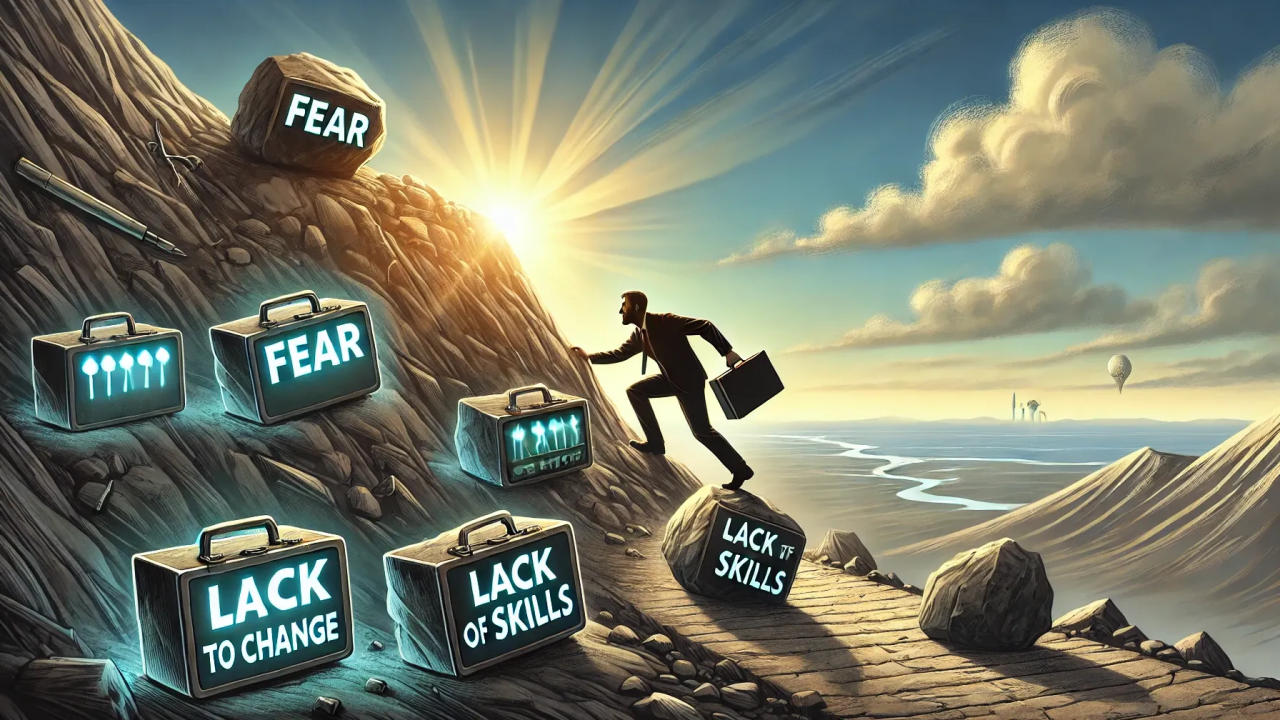
Innovation in companies is often discussed as a strategic imperative, but its implementation faces numerous obstacles, and one of the biggest challenges is the resistance to recognizing the existence of these impediments and the lack of necessary skills. While accepting these limitations is a fundamental step toward any meaningful progress, Many organizations struggle with this reality. But why does this happen?
There are several reasons, ranging from cultural and structural issues to power dynamics and fear of vulnerability.
1. Risk aversion culture
Many companies, especially those already established, developed a culture of risk aversion. Organizations operating in competitive markets, with minimal margins of error, often adopt a conservative mindset, prioritizing stability over innovation. In these environments, admitting obstacles or gaps in competence is seen as a vulnerability, and not as a learning opportunity.
Employees end up following the example of leadership, who avoids admitting mistakes to protect his internal and external reputation. This attitude creates a culture where error is penalized, and not treated as an opportunity for adjustments and learning, blocking the innovative process. Companies with this mentality end up preferring to maintain the status quo rather than taking chances on new ideas, even knowing that this could be harmful in the long term.
2. Departmental silos and lack of systemic vision
Innovation requires a broad and integrated vision of how different sectors of the company can work together. However, in organizations where the structure is highly departmentalized, There is a tendency to isolate roles and responsibilities, creating silos that make it difficult to exchange information. This segmentation makes the areas operate independently, without having a clear vision of how your limitations affect the whole.
In a scenario like this, Admitting a lack of competence in an area can be seen as a threat to the power of a specific department. If a sector admits that it does not have the necessary skills to innovate, It may be that another department is called upon to intervene, decreasing the perception of relevance or power of the former. Instead of seeking collaboration, leaders focus on protecting their territories.
3. Fear of change and uncertainty
Innovation involves, necessarily, to change. However, Many leaders and employees feel uncomfortable with the unknown. Change brings uncertainty, which can be seen as a threat to employment, responsibilities or even professional identity. Therefore, accepting skills gaps and obstacles can be particularly difficult, since admitting these limitations implies the need to reformulate processes and redesign functions.
This fear of change is amplified by pressure for short-term results. Companies that operate under constant pressure to deliver immediate profit may view innovation as an unnecessary risk. Adopting an innovative approach often requires a significant initial investment in time and resources, plus an adaptation period. When company culture is focused on quarterly goals, the long-term vision needed to sustain real innovation ends up being sacrificed.
4. The myth of self-sufficiency
Another point that prevents companies from recognizing their limitations is the belief in the myth of self-sufficiency. Many organizations, especialmente aquelas que alcançaram um grande sucesso no passado, tendem a acreditar que possuem todas as competências e recursos internamente para resolver qualquer problema. Essa mentalidade é particularmente comum em empresas que lideram seus mercados. Elas caem na armadilha de achar que, porque foram bem-sucedidas até o momento, não precisam mudar sua abordagem ou adquirir novas habilidades.
Essa ilusão de autossuficiência gera um problema sério: a empresa fica isolada das tendências do mercado e da inovação externa. Negar que outras empresas ou parceiros externos podem ter as competências ou insights necessários para enfrentar novos desafios é uma estratégia de estagnação.
5. Falta de liderança corajosa e empática
The ability to recognize gaps and obstacles is directly linked to leadership style. One of the most important roles of a leader is to create an environment where employees feel safe to admit mistakes., propose ideas and question established processes. However, Many leaders still operate under traditional models, where success is measured by the absence of failures and the maintenance of absolute control.
Leaders who fail to show vulnerability — which is the courage to admit they don't have all the answers — end up creating a climate where no one feels comfortable acknowledging obstacles.. The innovation, however, requires exactly the opposite: leaders who demonstrate empathy, encourage experimentation and treat failures as part of the creative process.
6. Pressure for quick results
Innovating takes time, and time is not always a luxury that modern companies have. The pressure for quick results and the search for immediate efficiency often hinder the development of creative solutions. Companies that have a more traditional view of performance end up focusing on the short term and require that all resources be optimized towards clear operational goals.
Admitting the lack of skills — which may lead to the need for training, hiring or even external partnerships — is seen as a delay or as an investment that will not bring immediate returns. Instead of investing in innovation, companies end up concentrating their efforts on actions that guarantee quick returns, even if it means sacrificing the ability to innovate in the long term.
“To innovate, you need more than good ideas; you need an ecosystem that embraces failure, learning and adaptation.” – Gary Hamel
Turning challenges into opportunities
So that companies can overcome these barriers, It is crucial that organizational culture is adjusted to value continuous learning, transparency and collaboration. Innovate, after all, It's not just about generating new ideas, but about recognizing flaws and gaps and being willing to correct them.
Innovative companies are those that can create a safe psychological environment, onde os colaboradores podem expressar suas preocupações, dúvidas e desafios. Elas sabem que a verdadeira inovação acontece quando todos — desde o nível operacional até o estratégico — trabalham juntos para enfrentar os obstáculos, admitindo que, sometimes, é necessário buscar ajuda externa ou desenvolver novas habilidades.