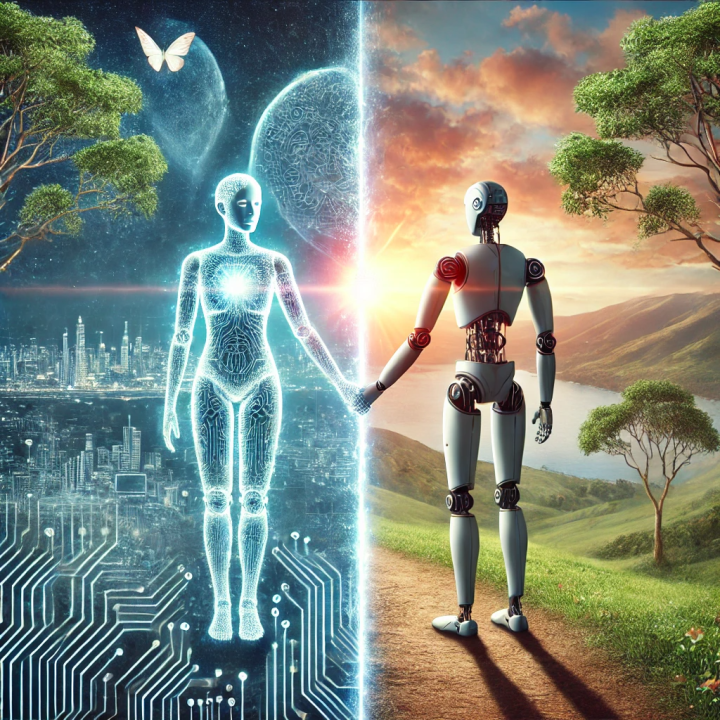
In contemporary debates about the future of work, It is common to find a dichotomy between artificial intelligence (IA) and human beings, as if the rise of AI would threaten the very existence of humanity in the job market. However, This opposition is a fallacy. Just as the Industrial Revolution came to complement human work, AI will have the same function. The essential difference is in the type of work that is affected; while the Industrial Revolution replaced some manual labor, AI replaces part of the intellectual work. But this does not mean that human beings will be replaced completely..
During the Industrial Revolution, Many feared that machines would replace workers, leading to mass unemployment. At that time, machines were seen as enemies of workers. Played, for example, destroyed automatic looms in protest against the mechanization that, according to them, threatened their livelihoods. However, with time, it became clear that machines not only increased productivity, but they also created new forms of employment and entire sectors of the economy.
According to historians, the Industrial Revolution not only transformed the economy, but also generated new opportunities. In “A Wealth of Nations”, Adam Smith argued that the division of labor and the use of machines could significantly increase efficiency and productivity, resulting in economic growth that would benefit society as a whole. E, in fact, mechanization led to the creation of new jobs in sectors such as manufacturing, transport and services, in addition to increasing the standard of living of many people.
Similarly, AI promises to transform the landscape of intellectual work. Instead of seeing AI as an adversary, it is more productive to consider it a powerful tool that can expand human capabilities. AI's potential to analyze large volumes of data quickly can free workers from repetitive tasks and allow them to focus on more creative and strategic activities. For example, in the health sector, AI can help doctors diagnose diseases based on complex exams, allowing healthcare professionals to focus on caring for and interacting with patients.
Besides that, The history of technology shows that innovation generally creates more jobs than it destroys. A study by the McKinsey Global Institute estimates that, although about 15% of current jobs can be automated, new jobs will emerge in areas such as AI development, maintenance of automated systems and in sectors that today we cannot even predict. During the Industrial Revolution, factory jobs increased, and new industries, like the car, emerged. In a similar way, AI is promoting the emergence of new professions and economic sectors.
The fear that AI will replace human work is understandable, but is not based on robust historical or economic analysis. Just as machines complemented human work in the past, AI can do the same today. The real challenge is adapting our skills and educational systems to prepare workers for this new reality. As economist Joseph Schumpeter observed, Technological innovation is a process of “creative destruction”, where old jobs and sectors are replaced by new ones.
Instead of fearing AI, we must embrace its potential to transform human work, increasing efficiency and opening new opportunities. History teaches us that, with appropriate adaptation, technology can be a powerful ally in building a better future. The opposition between AI and human beings is, therefore, a false dichotomy; both can coexist and thrive together.