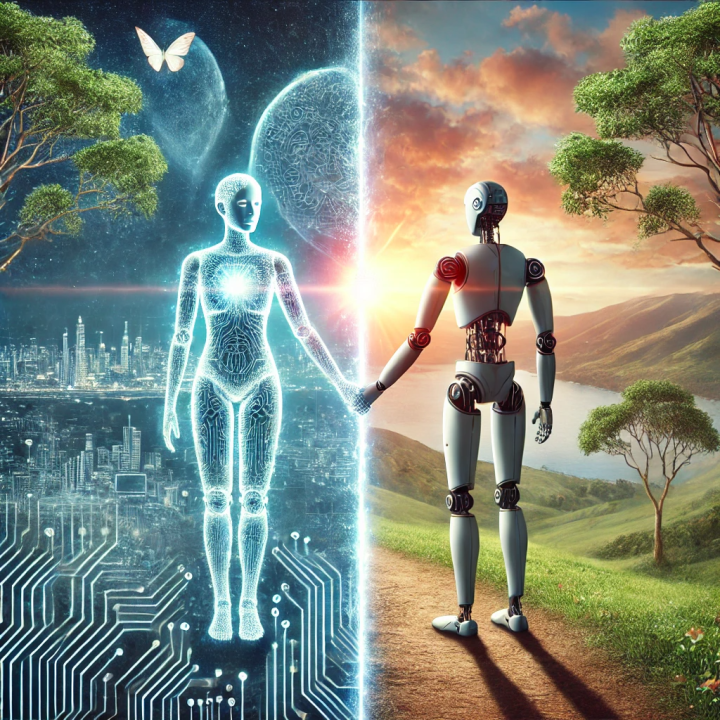
In contemporary debates about the future of work, é comum encontrarmos uma dicotomia entre inteligência artificial (IA) e seres humanos, como se a ascensão da IA fosse ameaçar a própria existência da humanidade no mercado de trabalho. However, essa oposição é uma falácia. Assim como a Revolução Industrial veio para complementar o trabalho humano, a IA terá a mesma função. A diferença essencial está no tipo de trabalho que é afetado; enquanto a Revolução Industrial substituiu parte do trabalho braçal, a IA substitui parte do trabalho intelectual. Mas isso não significa que o ser humano será substituído por completo.
Durante a Revolução Industrial, muitos temeram que as máquinas substituiriam os trabalhadores, leading to mass unemployment. At that time, machines were seen as enemies of workers. Played, for example, destroyed automatic looms in protest against the mechanization that, according to them, threatened their livelihoods. However, with time, it became clear that machines not only increased productivity, but they also created new forms of employment and entire sectors of the economy.
According to historians, the Industrial Revolution not only transformed the economy, but also generated new opportunities. In “A Wealth of Nations”, Adam Smith argued that the division of labor and the use of machines could significantly increase efficiency and productivity, resulting in economic growth that would benefit society as a whole. E, in fact, mechanization led to the creation of new jobs in sectors such as manufacturing, transport and services, in addition to increasing the standard of living of many people.
Similarly, AI promises to transform the landscape of intellectual work. Instead of seeing AI as an adversary, it is more productive to consider it a powerful tool that can expand human capabilities. AI's potential to analyze large volumes of data quickly can free workers from repetitive tasks and allow them to focus on more creative and strategic activities. For example, in the health sector, AI can help doctors diagnose diseases based on complex exams, permitindo que os profissionais de saúde se concentrem no cuidado e na interação com os pacientes.
Besides that, a história da tecnologia mostra que a inovação geralmente cria mais empregos do que destrói. Um estudo do McKinsey Global Institute estima que, embora cerca de 15% dos empregos atuais possam ser automatizados, novos empregos surgirão em áreas como desenvolvimento de IA, manutenção de sistemas automatizados e em setores que hoje nem podemos prever. Durante a Revolução Industrial, empregos em fábricas aumentaram, e novas indústrias, como a do automóvel, emergiram. De maneira semelhante, a IA está promovendo o surgimento de novas profissões e setores econômicos.
O medo de que a IA substitua o trabalho humano é compreensível, but is not based on robust historical or economic analysis. Just as machines complemented human work in the past, AI can do the same today. The real challenge is adapting our skills and educational systems to prepare workers for this new reality. As economist Joseph Schumpeter observed, Technological innovation is a process of “creative destruction”, where old jobs and sectors are replaced by new ones.
Instead of fearing AI, we must embrace its potential to transform human work, increasing efficiency and opening new opportunities. History teaches us that, with appropriate adaptation, technology can be a powerful ally in building a better future. The opposition between AI and human beings is, therefore, a false dichotomy; both can coexist and thrive together.